Unselected

Flat bicycle tyre: Why? What should you do?

It is a well known fact that a flat bicycle tyre can leave you feeling deflated. We explain why tyres deflate and how you can inflate them again, without any pressure.

Unselected

Air imperceptibly escapes from tyres and you do not understand why. Can a tyre deflate when it is not punctured? How can you repair a tyre that deflates slowly? We will show you how to detect the cause, repair the tyre, if necessary, and ride in peace of mind!

Unselected

How to understand whether your tyre is simply flat or punctured: the different causes

Pinch the tyre between your index finger and your thumb. It is deflated, but not completely flat. Is it punctured? Maybe not. What has happened? Be kind to the tyre, and to yourself. There is no doubt that a tyre that deflates when it is not punctured, and for no apparent reason, is annoying. But it is possible to explain and understand why a tyre deflates regularly, and to repair it, if necessary. We can offer a solution.

Unselected

Why does my tyre deflate all on its own?

It is normal for a tyre to slowly deflate all on its own. The air trapped inside your bike tyre is made up of nitrogen and oxygen molecules. These very small molecules can escape through the inner tube and the tyre. This permeability causes the tyre to deflate. Even with a high-quality inner tube and tyre, this loss of pressure is quite normal, but it can take a long time, weeks, or even months.

On the other hand, if the air escapes in a matter of days when the tyre is not punctured the tyre may be damaged, the quality of the inner tube may be poor or the valve may be faulty.

Finally, in hot weather, air expands and occupies more space inside the tyre. This phenomenon can speed up the loss of air. But this loss of air is marginal and is difficult to detect in the short term.

Unselected

How can you repair a tyre that deflates slowly?

To repair a tyre that deflates slowly, it is necessary to:
👉 Detect where the air escapes from.
To do this, check the sides and the tread of the tyre for wear.
💡 If you find any cracks or abnormal deformation on the sides of the tyre, a flat surface instead of tread, then your tyre is showing signs of serious fatigue. In this case, the tyre is no longer airtight, which explains why it deflates quickly. It must be replaced.
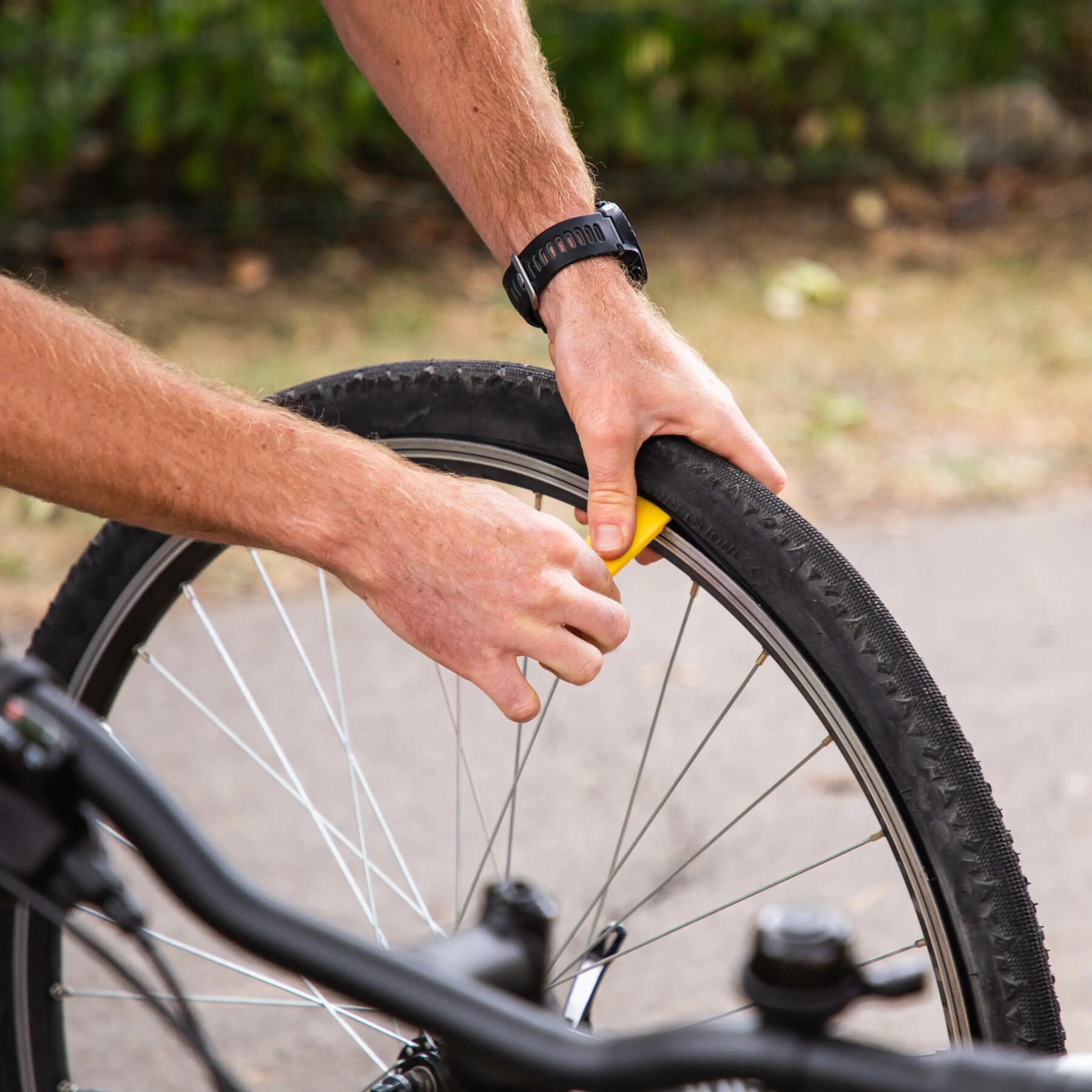
We explain how to replace the tyre of your bike here.

👉 Also, take a look at the inner tube, which may have become porous, or very porous, if it is old. Over time, the quality of the rubber deteriorates and can allow the air to escape in just a few days. Observe the quality of the rubber by stretching the inner tube.
💡 If the inner tube is too elastic and insufficiently dense, then it needs to be replaced.

👉 Check the condition of the valve too. Take out the inner tube, inflate it and immerse in a bucket of water to check whether the air escapes in the shape of bubbles.
💡The inner tube must be replaced if any air escapes.

Unselected
the correct pressure for a bicylce tyre

What is the correct pressure for a bicycle tyre? Where can you find the right pressure?

The pressure is shown on the side of the tyre. It is measured in bar or PSI. You will find the maximum pressure that must not be exceeded and, often, the optimal pressure range of your tyres.

Example: Tyre 1: maximum pressure (max. inflation): 6.2 bar, 90 PSI; Tyre 2: Range: 2.7 - 3.8 bar.

👉 Adapt the pressure to your activity:
If you only ride on tarmac roads, set the pressure of your tyres to the top of the pressure range. You ride on and off roads? In this case, adjust the pressure to a value in the middle of the range. Do not over-inflate.
If you ride on all types of surfaces, the pressure must be lower, but within the limits of use of the tyre. A lower pressure will improve comfort and the grip of the tyres on stony and uneven surfaces.

👉 Adjust the pressure to your weight: your weight must also be taken into account to set the pressure of the rear tyre. The pressure must be higher if you are heavy. Always remember to remain within the limits of use of the tyre.

Finally, listen to yourself. If you ride regularly, you will quickly find out the tyre pressure that best meets your expectations in terms of comfort, performance, precision and grip. You will find the right pressure for you by riding!

Unselected

How to know whether you have a slow puncture

You can detect a slow puncture according to theme the tyre takes to deflate. If your tyre is flat after a few hours or a few days, then there is almost certainly a hole or a foreign body in the inner tube.

Usually a slow puncture causes the tyre to deflate faster than or natural air loss.

Remember that there may also be a serious defect of the valve or the inner tube. This can result in a loss of air that is sufficiently significant or rapid for you to think that the inner tube is punctured. To be sure, immerse the inner tube and the valve in a bucket of water. If any bubbles rise to the surface, then there is a puncture.

Unselected

Punctures: how to use the repair kit

Unselected

What are the risks of riding with a deflated tyre?

Yes, it is dangerous to ride with a deflated tyre, because the tyre does not provide the same grip, the brakes are less efficient, so the braking distance is longer. In general, road-holding is far less precise with a deflated tyre, the bike wanders, without any real grip on the ground, and with very low pressure, the tyre can even come off the wheel rim and cause you to fall.

Unselected

Incorrectly inflated tyres: a review of the risks

Incorrectly inflated tyres are subject to more frequent deformation and punctures.

👉 I expend more energy than usual: when the tyre is not sufficiently inflated, the contact surface with the ground is larger, friction is increased and efficiency is reduced. In other words, you have to expend more energy to ride at the same speed than with correctly inflated tyres.

👉 The lifespan of the tyre is shortened: If your tyre is under- or over-inflated, its structure is subjected to abnormal aggression and forces that reduce its durability and performance.
 

Unselected

Before getting on your bike, take the time to check that your tyres are properly inflated using a pump equipped with a pressure gauge and follow the pressure values on the sides of the tyres. The difference in terms of safety, grip, performance and lifespan is significant! It also makes for a more pleasant ride. Pumping up your tyres is well worthwhile.

Unselected

Julien

A adventurer who enjoys riding up hills and down valleys, with his lunch in his bag and a compass.