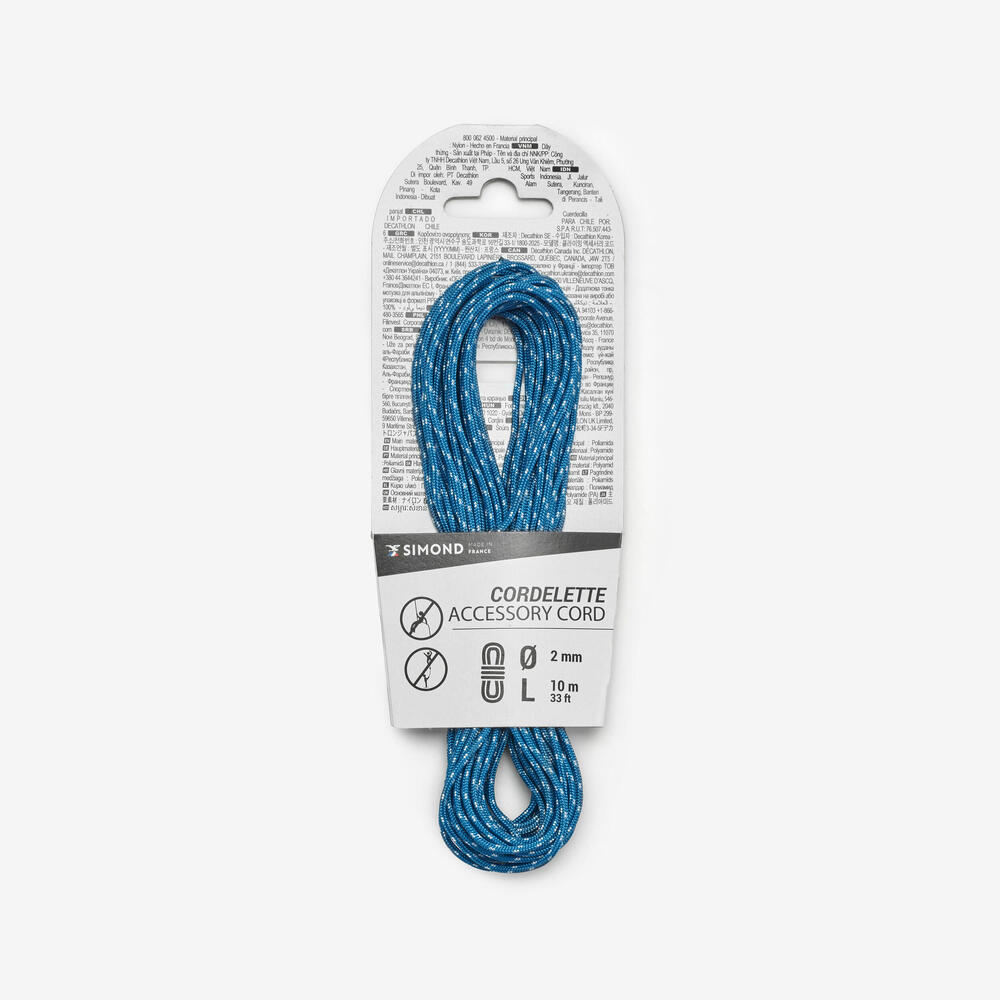
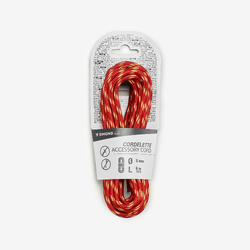
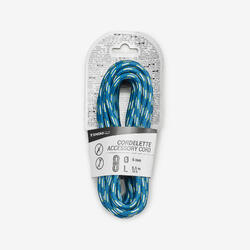
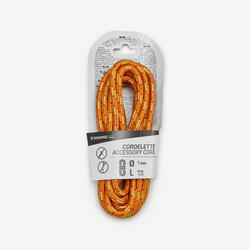
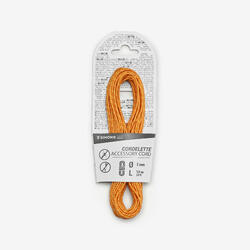
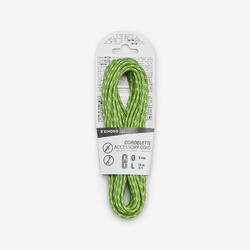
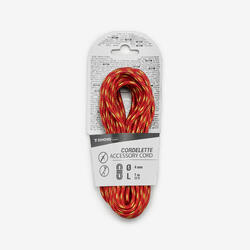
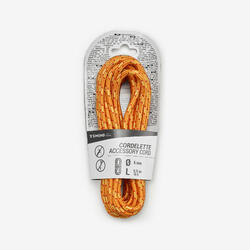
8174618

REF: 8174618, 8174619, 8174620, 8174621, 8174622

Accessory Cord: instructions and maintenance

2025

Keep your accessory cord in good condition for a long time by following our maintenance tips.
Be ready to set off on new adventures.

First use

Before using the product in a real-life situation, your safety is our priority. Take a few moments to familiarise yourself with your new Simond dynamic ropes. It is essential to check that the product you have received is the one you ordered (model, locking type) and that it clearly bears the safety markings (CE and UIAA standards). Also, make sure that the user manual provided is included.

Climbing and mountaineering are dangerous activities. By using this product, you assume responsibility for your own safety and actions, as well as the risks and consequences associated with its use.

What should I check before using my Simond dynamic ropes for the first time?

Before and after each use, visually and manually check the overall condition of the rope. Replace the rope as soon as possible after a significant fall or as soon as any damage appears.

1. Visual and tactile inspection
Sheath integrity:
Run your fingers along the entire length of the cord and visually inspect it for any cuts, bulges, or significant abrasions.
Burn marks: Check for any melted or hardened areas that could result from friction or a heat source.
Core homogeneity: Slide the cord between your fingers to ensure that the core (the inner part) is continuous and does not have any ‘soft’ areas or voids.

2. Identification and traceability
Date of manufacture:
Check the year of production (often indicated on the label of the spool or original packaging). For textile equipment, the maximum lifespan is generally 10 years of use (to which a prior storage period may be added).
Compliance: Ensure that the cord meets safety standards (CE marking, UIAA).

3. Suitability for use
Diameter and material:
Check that the diameter of the cord is suitable for the knot you want to tie (for example, for a Prusik-type self-locking knot, the cord should be significantly smaller in diameter than your climbing rope).
Closing knot: If you are making a loop with your cord, check that your knot (usually a double fisherman's knot) is perfectly tied and tight, and that there is enough slack (free strands) after the knot (about 10 times the diameter).

Safety reminder: Any modification or attempt to repair a cord is strictly prohibited. If you have any doubts about its integrity, do not use it.

How can I make a ring with my cord safely?

To transform your piece of string into a ring that can be used for mooring or a self-locking knot, you must follow strict assembly rules:

The reference knot: Only use a double fisherman's knot to close your ring, as it offers the best stability under load for this type of fabric.

The rule for loose ends: Once the knot is tightened, make sure to leave a length of free strand at least equal to 10 times the diameter of the cord (for example, 7 cm for a 7 mm cord).

Checking before use: Before each use, visually check that the knot is tight and that there is no visible slippage of the strands.

Appropriate diameter: If you are creating a loop for a self-locking knot (Prusik, Machard), ensure that the diameter of your cord is smaller than that of the rope on which it will be installed to ensure effective locking.

Nomenclature

A dynamic rope is a versatile textile product composed of two inseparable structural elements that ensure its strength and protection.

The core is the inner part of the cord. Made of high-tenacity polymer threads, it provides most of the tensile strength. It supports the load when tying a mooring or a self-locking knot. It is sensitive to violent shocks and chemicals that can alter its mechanical properties.

The core is protected by the sheath, the outer braided covering. Its role is to protect the core from external damage such as abrasion on rocks, cuts and UV rays. It is also the sheath which, due to its texture, provides the necessary grip when tying safety knots (such as the Prusik or Machard).

The entire product is identified by a traceability marking (found on the label or the original spool).

Warning: training required

Climbing and mountaineering are dangerous activities. By using this product, you
assume responsibility for your own safety and actions, as well as the risks and consequences associated with its use.

ADVICE
This product is a dynamic rope for climbing and mountaineering. This product has been designed for use with personal protective equipment against falls from a height that complies with current standards. Only persons trained and competent in mountaineering and climbing techniques, or under the direct and constant visual supervision of persons trained and competent in these techniques are authorized to use this equipment. Do not use this equipment without prior training or if you are in any doubt. You are also responsible for keeping up to date with any updates to your equipment. Ensure that the components of the belay system are compatible with each other, and that none of the components of the belay chain affect the operation and safety functions of any other component.
The rope is personal equipment. It may suffer unseen damage in your absence. For better product follow up, and when the rope is used by a group, we advise you to appoint a user or a person responsible for each product. We also advise you to be particularly vigilant when using the rope for the first time, as a new rope can be surprisingly slippery. The rope is 100% PA6, unless Covershield technology is mentioned on the packaging.
Rope name + Covershield: The rope contains UHMWPE. Please note that ultra high-molecular-weight polyethylene (UHMWPE) has a low melting point of 140°C and a low coefficient of friction.

How to use this dynamic rope?

Here are some different situations in which you can use your cord:

ADVICE ON ACTIVITIES
- Before and during use, consider the measures to be taken for safe and efficient rescue.
- Check carabiners and other equipment for burrs and/or damage.
- The figure-of-eight knot is recommended for roping climbers together.
- Check rope length before abseiling or top roping. To be on the safe side, tie a knot at the end of the rope.
- Use a carabiner or quick link for abseiling and top-roping. Do not pass the rope around a branch, over a ring, through the eye of a piton or directly through a plate.
- Avoid rapid descents when abseiling or top roping, as they accelerate wear and can burn the rope. The maximum permissible operating temperature is 80°C for short periods.
- The rope must not come into contact with corrosive and aggressive materials or chemical agents (acids, oils, petrol) which can destroy the fibers without being visible.
- Do not walk on your rope.
- Beware of shrinkage: whatever the construction of the rope, its use leads in varying proportions to a reduction in its initial length.

MOUNTAIN
The rope must be protected from sharp edges and falling rocks, which can cut the threads. If the rope has been wet, it loses its strength and is much more sensitive to abrasion.
CLIMBING
- Overlapping two ropes in a carabiner or connector can cause it to break.
- A rope bag protects your rope from dust, reduces the risk of twisting and makes it easier to transport. Getting into the habit of tying the end end of the rope inside the rope bag is an added safety feature when top ropin

How to inspect your dynamic rope?

Before and after each outing, check the general condition of the rope both visually and by hand. Replace the rope as soon as possible after a major fall or as soon as deterioration appears

What is the lifespan of this dynamic rope?

Total life corresponds to the storage time before first use, plus the use-by period. It is limited to a maximum of 13 years from the date of manufacture. The maximum recommended service life from first use is :
- 10 years for occasional use (up to 10 uses/year)
- 3 years for regular use (up to 50 uses/year)
- 1 year for intensive use (more than 50 uses/year)
This service life must be reduced if the total service life reaches 13 years. This service life may be reduced to a single use if the product has been dropped, overloaded, jammed or twisted, used intensively or subjected to heavy stress (e.g.after a fall, exposure to hazardous chemicals, extreme temperatures, etc.). As soon as your product no longer meets the inspection requirements described in the INSPECTION section, it must be disposed of. If in doubt about the condition of the product, have it checked by a competent, trained person, or dispose of it. The EU declaration of conformity of your product is accessible on the web page of the relevant rope on the www.supportdecathlon.com website.

How long is the warranty period?

SIMOND dynamic ropes are guaranteed for two years from the date of purchase against any manufacturing defects. Normal wear and tear, as well as any damage resulting from misuse or modification of the product, are excluded from this guarant

Cleaning and storage

Service life depends on frequency and type of use. Mechanical stress, friction, UV rays and humidity cause the rope to age and wear. The rope can suffer irreparable damage from the very first use. Wash in clear, cold water (soap and machine wash possible, but no detergent). Store in the shade, away from humidity, frost, UV rays and any source of heat likely to degrade the rope’s properties. If the rope is damp, do not store it in an airtight room or rope bag. For proper drying, the rope should be unfolded and hung in a shaded, ventilated area, away from frost and UV rays.

FOR US ONLY

For US market
Decathlon is not liable for accidents or injuries due to improper use of the product, failure to adhere to the instructions given in this guide, or modifications to the product. To avoid serious injury or death, follow the safety information in this document. Keep these instructions. While every effort has been made to ensure that the information contained in the guide is accurate and complete, Decathlon is not liable for any errors or omissions. Braking system are not toys. This product is not intended for use by children 12 years of age or younger. Youth of ages 13 to 17 should only use braking system under the direct supervision of an adult. An adult should review and explain the full set of instructions in this guide with the youth (age 13 years and over) before going climbing

How to maintain your dynamic rope?

Dynamic rope inspection and maintenance

How to inspect your dynamic rope?

Before and after each outing, check the general condition of the rope both visually and by hand. Replace the rope as soon as possible after a major fall or as soon as deterioration appears.

Regarding taking care and mantenace of your dynamic rope, service life depends on frequency and type of use. Mechanical stress, friction, UV rays and humidity cause the rope to age and wear. The rope can suffer irreparable damage from the very first use. Wash in clear, cold water (soap and machine wash possible, but no detergent). Store in the shade, away from humidity, frost, UV rays and any source of heat likely to degrade the rope’s properties. If the rope is damp, do not store it in an airtight room or rope bag. For proper drying, the rope should be unfolded and hung in a shaded, ventilated area, away from frost and UV rays.

Traceability

UNI / Unique Identification Number : enables the production chain to be traced and all rope characteristics to be identified. All ropes are delivered with instructions for use, a product label and end labels containing regulatory information. For their own safety, or in the case of a rope cut into several lengths, it is the user’s responsibility to ensure that the rope end markings are present at each end.

Declaration of conformity - Dynamic ropes