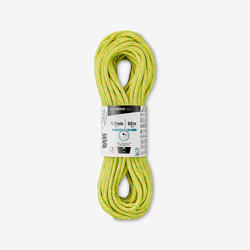
8797190

REF: 8797190, 8798308, 8798309, 8798310, 8798311

Semi static ropes: instructions and maintenance

2025

Keep your semi-static ropes in good condition for a long time by following our maintenance tips.
Be ready to set off on new adventures.

First use

Before using the product in a real-life situation, your safety is our priority. Take a few moments to familiarise yourself with your new Simond semi-static ropes. It is essential to check that the product you have received is the one you ordered (model, locking type) and that it clearly bears the safety markings (CE and UIAA standards). Also, make sure that the user manual provided is included.

Caving, canyoning, ropework and work at height, rescue or safety practices are dangerous activities. The following advice does not eliminate all the risks associated with these activities. The manufacturer declines all responsibility in case of abuse and/or misuse of the equipment. The user is responsible for the actions and decisions they make in the field. For the safety of the user, the dealer must provide this manual in the language of the country of use of the product.

What should I check before using my Simond semi static ropes for the first time?

The initial inspection is a mandatory safety step. Before your first outing, you must perform the following checks:

Complete manual and visual inspection: Run the entire length of the rope through your hands. You must check for irregular diameter, localised abrasions, signs of internal wear or abnormally soft areas (‘voids’ in the core).

Sheath integrity: Ensure there are no burn marks or cuts and that the sheath threads are not cut or frayed.
Markings check: Check the sticker label at the ends. It must be perfectly legible and indicate the type (A or B) and diameter (10.5 mm).

Date of manufacture and lifespan: Note the date (MM/YY) to ensure that the product has not exceeded its maximum storage life of 5 years before its first use (the total lifespan is 15 years).

Checking associated components: Check your carabiners and descenders for burrs or sharp edges that could damage the new fibres of the rope.

Important reminder from your instructions:
The rope is personal equipment. If it has been unpacked or handled in your absence, it may have suffered invisible damage. If in doubt, do not use it.

What are the limits of use for my semi-static rope?

It is essential to understand that this rope is not designed for all purposes:

Prohibited for free climbing: If there is a risk of falling, you must use a dynamic rope (EN 892). Static rope must never be used if a fall factor greater than 1 is possible.

Anchor position: For your safety, the anchor point must never be below the user.

Temperature: Be careful of descents that are too fast, as they can heat up the sheath. The maximum permissible limit is 80°C.

Nomenclature

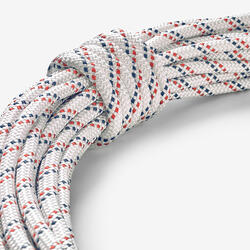
The core is the inner part. This high-tenacity fibre core provides resistance to static stress and limits elongation. It is critical: a violent impact or chemical contact (acid, oil) can destroy it from the inside without any visible signs.

The sheath is the protective covering. It protects the core from abrasion and UV rays. It is very sensitive to frictional heat: during a descent, the temperature must never exceed 80°C, otherwise the fibres will burn.

The assembly is defined by its Type (marking), indicated on the end label:
- Type A is the standard safety rope (rescue, work).
- Type B is a performance rope, thinner, requiring increased protection against wear.

Warning: training required

Caving, canyoning, ropework and work at height, rescue or safety practices are dangerous activities. The following advice does not eliminate all the risks associated with these activities.
The manufacturer declines all responsibility in case of abuse and/or misuse of the equipment. The user is responsible for the actions and decisions they make in the field. For the safety of the user, the dealer must provide this manual in the language of the country of use of the product.
How to use this semi-static rope?

How to use this semi-static rope?

This product is a static rope intended for caving, canyoning, ropework or work at height, rescue or safety operations. Its use must allow the movement, progress or descent of a person in accordance with the conditions set out below.
- If the user is practising free climbing, he/she must use a dynamic rope that complies with standard EN 892. Static ropes should never be used if the user could find him/herself in a position where they could suffer a fall above factor 1. For optimum safety, a reliable anchor point above the user is required, as well as avoiding ropes becoming improperly tensioned between the user and the anchor point.
- The user, in a normal situation or in an emergency, must be in perfect medical condition, physically and mentally, in order to use this static rope safely.
- This product must be used by trained and/or competent people or the user must be supervised by a trained and/or competent person.
- In order to prepare for any eventuality, before using this rope, a rescue plan must be drawn up and implemented if necessary. This product must in no case be modified or added to any other product without the prior agreement of the manufacturer, and any repair must be in accordance with the manufacturer’s operating instructions.
- This rope is designed to withstand the static forces involved in activities where there is a risk of falling from a height.
- The equipment must not be used beyond its limits or in any situation other than those mentioned above.
- The rope is personal equipment. In your absence, it can incur damage that may not be visible. For better surveillance, when the rope is used by a group, we recommend that you appoint a user or responsible person for each product.
- Thin ropes may require a specific belay device.
- The rope must be protected from sharp edges and falling rocks which can cut the threads. Check for kinks and/or damage to carabiners and other equipment. The overlap of two ropes in the same carabiner or link can cause the rope(s) to break. Descending too quickly and top-roping are to be avoided, as they cause premature wear and can burn the rope. The maximum permissible operating temperature is 80°C for a short time. Before abseiling or top-roping, check the length of the rope. As an extra precaution, tie a knot at the end of the rope.
- Before and after each outing, carry out a visual and physical inspection of the rope to check its general condition. Replace the rope as quickly as possible after a heavy fall or as soon as any damage appears. If in doubt, return the rope to the manufacturer.
- The user should consider the rope to be defective if there are traces of burns to the sheath, if the rope is nicked, if its diameter is irregular, if there are localised abrasions or traces of internal wear, noticeable lengthening compared to the original length or if it shows any other signs of deterioration. Visual and manual inspection is therefore required before each use. If the rope has become wet, it loses its strength and is much more sensitive to abrasion. Take all the necessary safety precautions.
- If there is any doubt about the safety of the equipment or if it has already been used to stop a fall and should not be used until a competent person has authorised its reuse in writing, the rope must be taken out of use.
- The minimum resistance of the anchoring device or chosen structure must be at least 15kN.Use a carabiner or rapid link for abseiling and top-roping. Do not run the rope around a branch, on a ring, in the eye of a piton or directly in a plate. The relay must consist of at least two independent anchor points. The various belaying components (harnesses, carabiners, straps, descenders, anchor points) must be chosen in accordance with European and/or EC-approved standards and be used with full knowledge of their limits of use in progression and in safety systems. They must also be adapted to the diameter of the rope.
- Beware of the danger of using multiple items for which the safety feature of one item is affected by the safety feature of another item interfering with it.
- The figure-eight knot is recommended for roping in. Make a really tight figure-eight knot. The minimum length of rope that must pass beyond the knot is 10 cm. On a fall arrest harness, use the tie-in points specified by the manufacturer.
- To minimise the risk of falling and the height of any fall: under no circumstances must the anchor point from the rope to the relay be positioned below the user, so as not to exceed Fall Factor 1.
- The fall arrest harness (compliant with EN361) is the only device for holding the body allowed in a fall arrest system (as per EN 363).
- Before and after use, the possible height of falls must be anticipated. The user must position him/herself in relation to his/her relay so as never to be above it. Always check the free space below the user (according to the instructions in each manual for the associated equipment) to avoid any collision with an obstacle.
- The rope must not come into contact with corrosive or aggressive materials or chemical agents (acids, oils, petrol) that can destroy the fibres without this being visible.
- During transport, a rope bag that protects the rope from dirt and reduces the risk of fraying is highly recommended.

How to inspect your semi-static rope?

- In order to guarantee the safety of the user which depends on maintaining the efficiency and strength of the equipment, regular examinations are necessary for the continued safe use of the product. Periodic examinations must take place every 12 months at the minimum. These examinations must be carried out by qualified personnel in accordance with the operating standards of the manufacturer. The legibility of the product’s markings must be checked. You must keep an identification form which allows you to record the following information: Equipment type, manufacturer, dates of manufacture, purchase and first use, log of regular checks and repairs.

What is the lifespan of this semi static rope?

- The lifespan of a piece of PPE depends on the frequency and mode of use. A rope in use undergoes stresses, tensions, impacts, and numerous mechanical stresses that put it to the test. Friction, abrasion, UV and moisture lead to ageing and inevitable wear. This stands, despite the technological advances we have made for our products over recent years. A rope can suffer irreparable damage from its first use, requiring immediate disposal. Be cautious and vigilant.
- The lifespan of a Simond item of PPE is limited to 15 years, including a storage period and a period of use.
- Possible storage period, in good conditions before 1st use: 5 years
- Maximum duration of use: 10 years.

How long is the warranty period?

SIMOND semi-static ropes are guaranteed for two years from the date of purchase against any manufacturing defects. Normal wear and tear, as well as any damage resulting from misuse or modification of the product, are excluded from this guarantee.

Cleaning and storage

Cleaning:
- The rope should be washed in clean, cold water. Any other cleaning technique is prohibited. The rope must always be dried in the shade away from any heat source. It should be stored in the shade, away from moisture, frost, UV and away from heat sources that may degrade the properties of the rope.
PLEASE NOTE: If the rope is wet, it should be allowed to dry in the shade, away from moisture, frost, UV and any heat source.
REGULAR CHECKS
- In order to guarantee the safety of the user which depends on maintaining the efficiency and strength of the equipment, regular examinations are necessary for the continued safe use of the product. Periodic examinations must take place every 12 months at the minimum. These examinations must be carried out by qualified personnel in accordance with the operating standards of the manufacturer. The legibility of the product’s markings must be checked. You must keep an identification form which allows you to record the following information: Equipment type, manufacturer, dates of manufacture, purchase and first use, log of regular checks and repairs.
REPAIRS
Any possible repairs must be carried out by competent persons authorised by the manufacturer and in accordance with the manufacturer’s operating procedures.

How to repair your semi-static rope?

Any possible repairs must be carried out by competent persons authorised by the manufacturer and in accordance with the manufacturer’s operating procedures.

FOR US ONLY

For US market
Decathlon is not liable for accidents or injuries due to improper use of the product, failure to adhere to the instructions given in this guide, or modifications to the product. To avoid serious injury or death, follow the safety information in this document. Keep these instructions. While every effort has been made to ensure that the information contained in the guide is accurate and complete, Decathlon is not liable for any errors or omissions. Braking system are not toys. This product is not intended for use by children 12 years of age or younger. Youth of ages 13 to 17 should only use braking system under the direct supervision of an adult. An adult should review and explain the full set of instructions in this guide with the youth (age 13 years and over) before going climbing.

Comment entretenir sa corde statique ?

Controle, entretien de corde statique et réparations

L'entretien régulier est le garant de la longévité de votre corde et, surtout, de votre sécurité.

1. Le contrôle (Avant et après chaque sortie)

Vous devez effectuer une inspection visuelle et manuelle systématique :

Visuellement : Cherchez des traces de brûlures (glaçage), des entailles, des fibres coupées ou des zones d'abrasion localisées sur la gaine.
Manuellement : Faites glisser toute la corde entre vos doigts. Si vous sentez un diamètre irrégulier, une bosse (hernie), ou au contraire une zone "molle" (usure interne de l'âme), la corde doit être retirée de la circulation.

2. L'entretien et le stockage

Lavage :
Utilisez exclusivement de l'eau claire et froide. Toute autre technique de nettoyage (savon agressif, machine à haute température) est proscrite.
Séchage : Faites sécher votre corde impérativement à l'ombre, dans un endroit ventilé, et à l'écart de toute source de chaleur (soleil, radiateur).
Stockage : Entreposez-la dans un endroit sec, à l'abri du gel, de l'humidité et des UV.
Transport : L’utilisation d’un sac à corde est fortement recommandée pour la protéger de la saleté et éviter la formation de nœuds (torons).

3. Réparations et Modifications


Interdiction de modifier : Ce produit ne doit en aucun cas être modifié ou recevoir une adjonction supplémentaire sans l'accord de Simond.
Réparations : Elles sont extrêmement limitées. Toute intervention doit être réalisée par une personne compétente, autorisée par le fabricant, et selon ses modes opératoires précis.
Contact chimique : Si votre corde entre en contact avec des matières corrosives (acide de batterie, huiles, essences), elle doit être mise au rebut immédiatement, car ces produits détruisent les fibres de manière invisible.

Examen périodique : Un contrôle approfondi doit être réalisé au minimum tous les 12 mois par une personne qualifiée.- La corde doit être lavée à l’eau claire et froide. Toute autre technique de nettoyage est proscrite. La corde doit impérativement sécher à l’ombre et à l’écart de toute source de chaleur. Le stockage se fait à l’ombre, à l’abri de l’humidité, du gel, des UV et à l’écart de toute source de chaleur susceptible de dégrader les propriétés de la corde.
ATTENTION : Si la corde est humide, il faut la laisser sécher à l’ombre, à l’abri de l’humidité, du gel, des UV et à l’écart de toute source de chaleur.
Declaration of conformity - Semi static ropes